
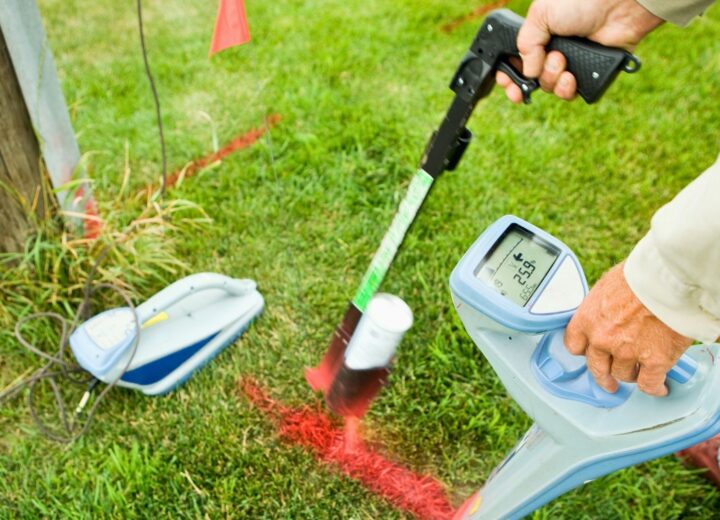
We’ve heard your questions about the flags and paint marking utility lines in your yard, why power outages affect neighborhoods differently and why AEP Ohio can’t build more power plants to meet rising energy demand. We are committed to keeping you informed about your electric service and the grid that brings you power. We’re answering our customers’ most asked questions below.
Who put these little flags and paint on my lawn?
Marking buried utility lines is a vital step before you do any digging or excavating on your property. OHIO811 coordinates free utility location services for all public utility lines. The process to request utility location differs a bit depending on the circumstances, so AEP Ohio encourages all customers to call 800-362-2764 or visit oups.org for more information and to request service. The information below explains what the different colors mean.
- Red is used to mark high and low voltage electric cables, including power lines, conduit and lighting cables.
- Yellow means gas lines are buried there. These could include natural gas, fuel oil, propane, pipelines and any other buried pipe that transports gas.
- Orange markings indicate communication lines, including telephone, cable and fiberoptic cable.
- Blue stands for potable water and could indicate a municipal water line or a line from a private well.
- Green is used for sewer lines.
The power went out in my neighborhood recently, so why did AEP Ohio mention a power outage in a different area?
The design of the electric grid is complex. It gets even more complicated as AEP Ohio develops innovative techniques to deliver power to neighborhoods in multiple configurations. This reduces the frequency of power outages and how long they last.
What this means for customers is that a power outage can start in one neighborhood and stretch into others without affecting all customers in any of the affected neighborhoods. This is even more relevant when a power outage involves transmission lines or a substation, both of which feed large geographic areas. So, for example, AEP Ohio might say that the power is out in Zanesville, and that same outage could also affect customers in Pleasant Grove, or power could be out in Grandview Heights and extend into Fifth by Northwest.
I keep hearing that there’s not enough electricity so why aren’t you building more power plants?
State law prevents AEP Ohio from building power plants and generating electricity. Starting with deregulation under Ohio Senate Bill 3 in 1999 and continuing with House Bill 15, passed by the state legislature in 2025, electric utility companies like AEP Ohio are not allowed to own or operate facilities that generate electricity.
While the cost of generating electricity is included in your monthly bill from AEP Ohio, it is a pass-through charge from the companies that generate electricity. AEP Ohio does not control how electricity is generated and AEP Ohio does not make any money from generation.
There is currently an imbalance between the amount of power being generated and the growing demand for it, increasing those generation costs for customers. Customers can choose a competitive energy supplier through the Public Utility Commission of Ohio’s (PUCO) Apples to Apples online comparison tool.
AEP Ohio is committed to safely delivering reliable power to our customers.

My experience with AEP has always been a great experience.
You should write an article about how you work with are regional transmission organization and how they are responsible for making sure there is enough power available to keep the lights on.
A street light went out one night. I called the next morning and it was taken care of that very day! Great customer service!
I have been trying to get a home energy audit on our house, but do not seem to find anyone locally to do it. Cuz AEP provide this service, or can you direct me to someone that can do an audit? Thank you
Hi Gary. We do not perform home energy audits and are unable to recommend any providers. We’re sorry we were unable to help with this request.