
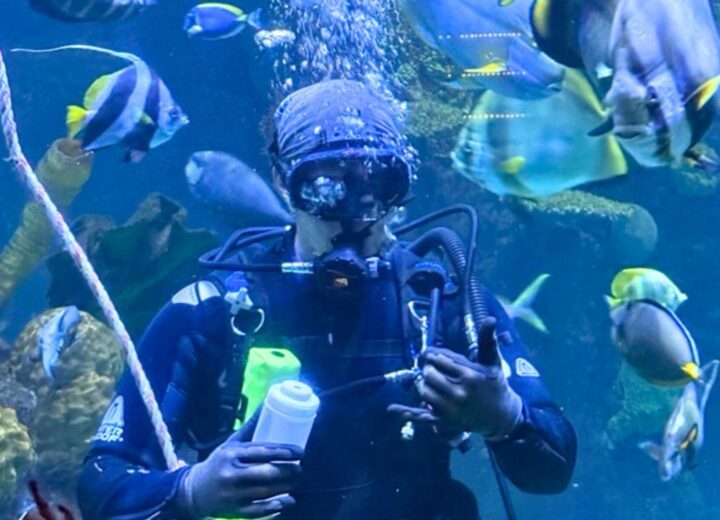
An AEP Ohio storeroom supervisor spends his free time diving with sharks, fish and other aquatic animals before a crowd of wide-eyed kids at the Columbus Zoo and Aquarium.
At first, all you can see is the cloud.
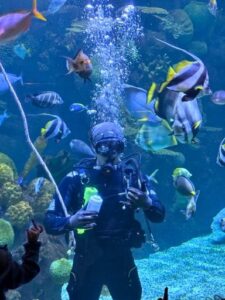
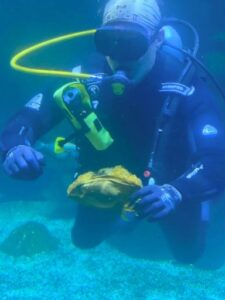
It billows up from the reef like an underwater storm — silver and electric blue, flashing scales, darting bodies — fish surging forward in a sudden, joyful frenzy. Somewhere inside that swirling mass is a human being in fins and a mask, hovering calmly, one gloved hand extended with food while the other keeps balance against the current created by hundreds of hungry mouths.
Kids press their faces to the glass. Parents lift phones. A Zoo educator narrates the chaos from dry land.
This is not a movie set or a marine research station off a tropical coast. This is the main reef at the Columbus Zoo and Aquarium — a regular AEP Ohio partner in programs like Trim to Treat and Wildlights — and the man inside the aquarium is Dustyn Douglas, storeroom supervisor for AEP Ohio.
By day, Douglas oversees storerooms at the southwest Columbus and Grandview service centers. He manages materials, inventory and logistics — vital, behind the scenes work that keeps crews moving and customers’ lights on. Off the clock, he straps on scuba gear and dives in.
“I always tell people Ohio is not a great state for regular diving,” Douglas said with a laugh. “But you work with what you’ve got.”
Diving in unlikely places
Douglas took up diving as a way to stay active while staying safe during the early days of the COVID pandemic. He’s been a certified diver for five years now, with a particular fondness for the Caribbean island of Bonaire — his favorite place to dive — and a soft spot for Ohio’s Gilboa Quarry, a renowned Midwest dive site located about 15 miles west of Findlay.
A couple of years ago, the Zoo put out a call for volunteers.
“It was a great way to start giving back while doing something I love,” he said. “And I already had the certification and equipment.”
Douglas volunteers eight to 10 times a year, logging dives that last anywhere from 30 to 60 minutes at a time. The Zoo provides almost everything — tanks, regulators and fins. He brings his own wetsuit and mask. The rest is training, muscle memory and calm breathing.
He dives in the main reef aquarium and with the otters and cleans the manatee habitat.
Feedings. Cleanings. Maintenance. And, sometimes, crowd control of a different sort.
“Some of these animals are always bumping into you,” he said. “Gnawing on you. They want to play. They want to interact.”
You’re a guest down there
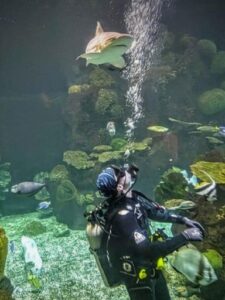
One of the regulars is a hawksbill sea turtle with a particular fondness for the water scrubber Douglas uses during cleanings.
“He loves it,” Douglas said. “I’ll be scrubbing algae, and he’ll just swim up and press his shell into it.”
The blacktip reef shark that glides through the water, by contrast, prefers to keep to itself.
“He just floats by,” Douglas said. “Does his thing.”
A front-row seat to wonder
During feedings, Douglas often brings food right up to the glass, intentionally drawing fish forward so visitors can see what’s happening. The result is a living curtain of movement — fish piling on fish, bodies flashing in the light, the water alive with motion.
Outside the aquarium, a Zoo employee narrates the scene. Inside, Douglas makes eye contact with kids and plays along — posing for pictures, gesturing, throwing up a quick game of rock-paper-scissors through the glass.
“One of the reasons I like doing this is because it gets kids interested,” he said. “In diving. In the ocean. In the animals that live there.”
That interest matters. It sticks. It’s the kind of moment a child remembers decades later when they’re deciding what kind of work feels meaningful.
Sometimes his dives include a little extra cheer, like a Santa suit.
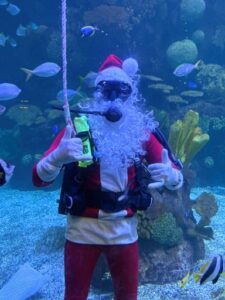
Yes, Douglas completed a Santa dive — full festive gear, underwater — as part of the Zoo’s holiday programming. It’s absurd. It’s delightful. And it’s exactly the kind of thing that helps make lasting memories.
Something bigger than the dive
“Maintaining the water quality for all our aquatic habitats is a significant task, but it is essential for the well-being of the animals that call them home,” a spokesperson for the Zoo said. “Our community of volunteer divers helps us to maintain this high standard of care.”
Then there are the zebra sharks, unique in that they reproduce asexually. Douglas’s duties include collecting the eggs that these sharks lay. Those eggs are then shipped out to be studied, contributing to broader research on shark reproduction and conservation.
“It’s wild,” he said. “You’re just there doing your job and then you’re like, ‘Oh, this matters in a much bigger way.’”
From laydown yards to living reefs
Douglas joined AEP Ohio in 2017 as a contractor working in transmission laydown yards. He moved into distribution field operations, built experience and eventually stepped into supervision. Today, he balances work with a busy home life — his wife and four kids anchoring everything.
That balance is part of the point.
Whether he’s managing materials that keep crews safe or scrubbing algae off aquarium walls while fish swarm around him, Douglas shows up with the same steady presence.
He maintains situational awareness. He plans ahead and anticipates likely errors. He identifies and mitigates the risks involved in the work.
Above water or below it, the fundamentals don’t change much.
Back in the reef, the feeding frenzy subsides. The cloud thins. The fish drift back to their corners. Douglas gives a final wave to the kids at the glass before slowly finning upward, bubbles trailing behind him.
It’s not the kind of thing you expect from a storeroom supervisor.
Which makes it that much more meaningful.

Thank you for your great contribution to our ecology. Really must be a lot of fun. Scuba is the most interesting and relaxing activity I have ever done.
How extremely cool!!
Great Article, Good for you Dustyn!
Thank you for volunteering your free time and giving back to the community.
Is a dive schedule available on the Zoo’s website? I’d like to bring the grand kids to watch you work/play 🙂
That was a wonderful show of what he was doing. He was honersble⛄️
This is a really cool story! This man found something that allows him to put his skills to work in a creative way that offers fulfillment and benefits not only to him, but also to the aquarium creatures and the folks visiting the zoo.
I particularly liked reading about how Dustyn Douglas gives a close-up view of the marine life in the aquarium to those on the other side of the glass.
I often visit the Columbus Zoo with my grandsons. The next time we have the opportunity to go, we will look for “The Man in the Aquarium”!
Awesome! We love our zoos & aquariums and appreciate what you’re doing to save/support our Marine life here in Ohio and around the world.
I did my first dive in Bonaire in about 1972, as I recall, it was Jack’s resort at the time and I understand his daughter is running it now. It is commendable that you are volunteering at the zoo. At 1 point I was a dive instructor.
I think that is amazing ,so happy that Douglas is doing this . Learned a lot reading this article . I will look for him the next time I am at the aquarium .Love. The zoo .
What a wonderful way to share his skills! Great article.